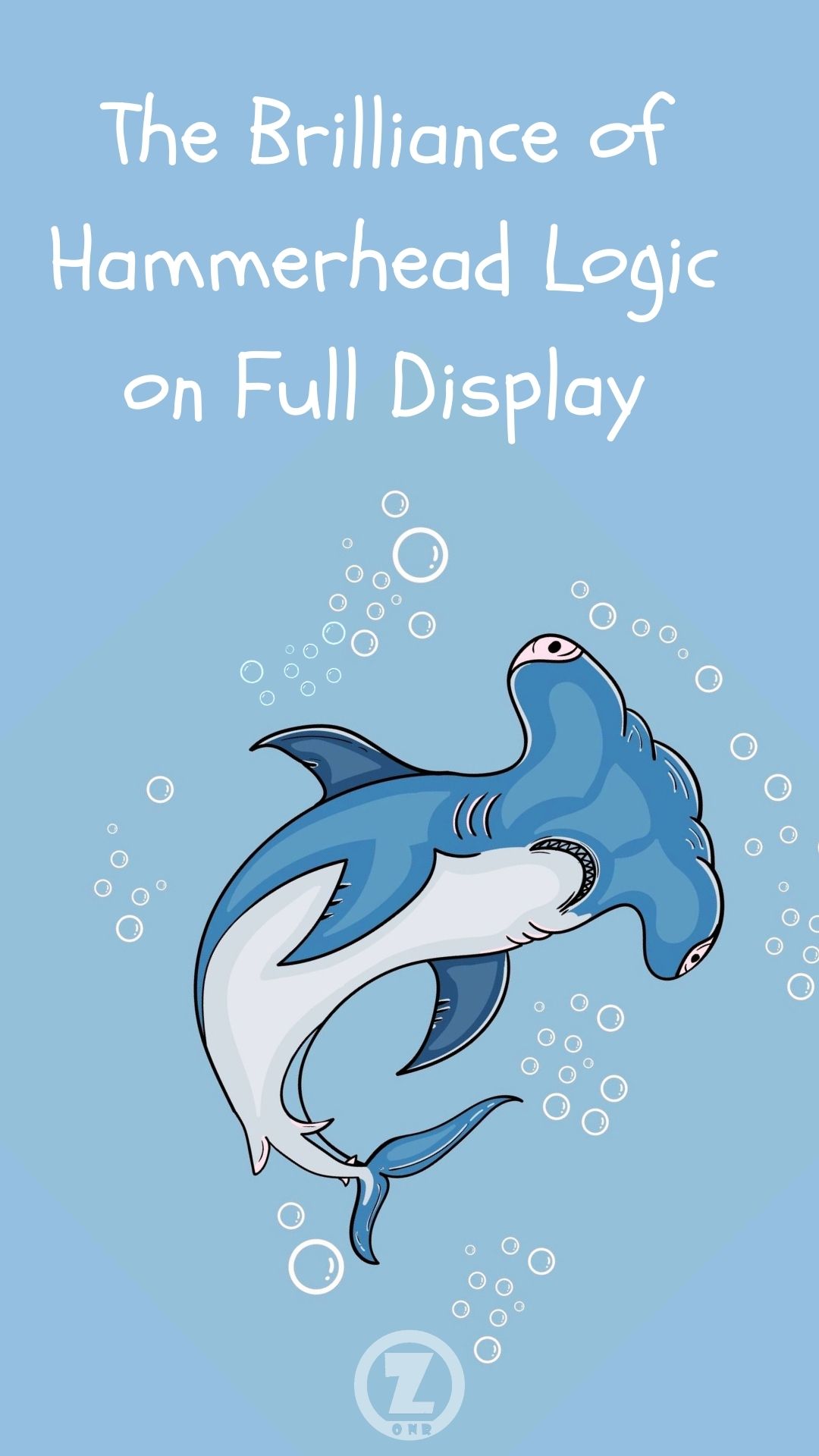
The Brilliance of Hammerhead Logic on Full Display – Step 6

Cartoon hammerhead shark confused w/ sfz title

Written by

in

,

“Against logic
there is no armor like
ignorance.”

– Laurence J. Peter (1919 – 1988) U.S., educator/author

~~~

Sign up to get Zonr for Today’s Full SFZ

How does your own hard-headedness (or stubbornness) cloud your thinking, lately?

OR

Why do people sometimes choose denial instead of facing the truth that could save them?

~~~

Cult Logic – Time lapsed video – Miike Snow (3:47)

Brain Hemisphere Hz Synchronizing Meditation (10:01)

English Analysis

The first passage from The Big Book uses a vivid image of hammer and headache. William James, in The Varieties of Religious Experience, notes that humans often cling to suffering rather than change. Like James, the text reveals how self-inflicted harm can feel like a strange relief. It shows denial as a shield that numbs but never heals.

The second excerpt from Crystal Clear demonstrates the progression of loss. Viktor Frankl, in Man’s Search for Meaning, describes how despair grows when life seems hopeless. Here, the narrator explains how impaired minds witness destruction yet deny personal risk. Through this lens, denial becomes survival’s false mask. The belief in endless use mirrors Frankl’s idea of living without meaning, which destroys freedom.

The third quote, by Laurence J. Peter, distills ignorance into armor. Socrates in Apology insisted that wisdom begins with admitting ignorance. By contrast, this ignorance defends the addict from confronting truth. Thus, logic cannot pierce the shield of willful blindness. Transitioning from Frankl to Peter, we see how distorted belief systems sustain cycles of harm.

Together, these passages highlight how self-deception grows into habitual suffering. Denial turns pain into a hidden companion. Ignorance blocks freedom by making destruction appear normal. Each thinker calls us to awareness, because only truth unlocks recovery.


Traducción al Español

Citas

“Parecen como
la filosofía del
hombre que, teniendo
un dolor de cabeza,
se golpea en la
cabeza con un mar-
tillo para no sentir
el dolor.”
(El Gran Libro, p. 23)

“Tal vez vimos a un
amigo ir a la cárcel, o
perder su apartamento, o
perder su trabajo, o perder
la confianza de su familia, o
morir. Pero nuestras mentes
nubladas no admitirían que
nosotros éramos los siguientes.
La mayoría no veía salida, creyendo
que usaríamos hasta el día
de nuestra muerte.”
(Cristal Claro, p. 8)

“Contra
la lógica no hay
armadura como
la ignorancia.”

  • Laurence J. Peter (1919-1988), educador / autor estadounidense

Análisis en Español

El primer pasaje de El Gran Libro usa una imagen vívida de martillo y dolor. William James, en Las variedades de la experiencia religiosa, nota que los humanos se aferran al sufrimiento. Como James, el texto muestra cómo el daño propio puede sentirse como alivio extraño. La negación aparece como un escudo que adormece pero nunca sana.

El segundo extracto de Cristal Claro muestra la progresión de la pérdida. Viktor Frankl, en El hombre en busca de sentido, describe cómo la desesperación crece cuando la vida parece sin salida. Aquí, el narrador explica cómo las mentes nubladas observan destrucción pero niegan el riesgo personal. Así, la negación se convierte en una máscara falsa de supervivencia. La creencia en el uso eterno refleja la idea de Frankl de vivir sin sentido, lo cual destruye la libertad.

La tercera cita de Laurence J. Peter reduce la ignorancia a una armadura. Sócrates en Apología insistió que la sabiduría empieza al admitir la ignorancia. En contraste, esta ignorancia protege al adicto de enfrentar la verdad. Así, la lógica no puede atravesar el escudo de la ceguera voluntaria. Al pasar de Frankl a Peter, vemos cómo las creencias distorsionadas sostienen el ciclo de daño.

En conjunto, los pasajes muestran cómo el autoengaño crece hasta convertirse en sufrimiento habitual. La negación convierte el dolor en un compañero oculto. La ignorancia bloquea la libertad al normalizar la destrucción. Cada pensador nos llama a la conciencia, porque solo la verdad abre la recuperación.

Pregunta: ¿Por qué la gente a veces elige la negación en lugar de enfrentar la verdad que podría salvarlos?

Zonr blog on clouds

Comments

5 responses to “The Brilliance of Hammerhead Logic on Full Display – Step 6”

  1. Eli???????????????????? Avatar
    Eli????????????????????

    While drinking I couldn’t think of anything else. There was nothing else for me. Nothing mattered. I forgot how much caring hurts. It’s a painful reconciliation.

  2. Elexi W.S.A. Avatar

    Sometimes I find it very helpful to listen to advice and I think people choose denial instead of facein’ the truth because to admit we’re wrong at times may make us feel very lowly. Lowliness can bring on low esteem at times further making us think we can’t achieve, so how someone talks to someone is key, and very important.

  3. E-Dawg Avatar
    E-Dawg

    I think a good example of staying in denial is the person is simply not willing… there is a certain distorted Security in familiar pain. It seems safer to embrace what we know than to let go of it for the unknown.

  4. Sabrina J Avatar
    Sabrina J

    We ask our Higher Power to remove our defects. Yet when we are stubborn, hard headed, think we know better, there is a great likely opportunity for a lesson in Humility.

    Socrates told the Delphi, “I know that I don’t know” and this wisdom was the sign of his infinite desire learn and be open. I pray to always be to learning new things and never closing down.

    Thank you for sharing recovery with me. Grateful.

  5. Bodhi Baba Avatar
    Bodhi Baba

    FEATURED POST FROM THE ZONR VAULT – “Once I decide something, I have to be slapped in the face with reality before I will even begin to consider changing my mind. This especially comes to my opinions about people. I don’t hate anyone, but I will judge in my head while smiling the whole time. And I decide this person will never be in my circle. And I don’t even truly know this person. And especially in AA, people change. So I hope I learn to not be so harsh. Chances are I’m getting that right back sometimes.” (Adam 9/9/2012)

Leave a Reply

Your email address will not be published. Required fields are marked *

This site uses Akismet to reduce spam. Learn how your comment data is processed.